
The Core Issue: Earth’s Energy Imbalance
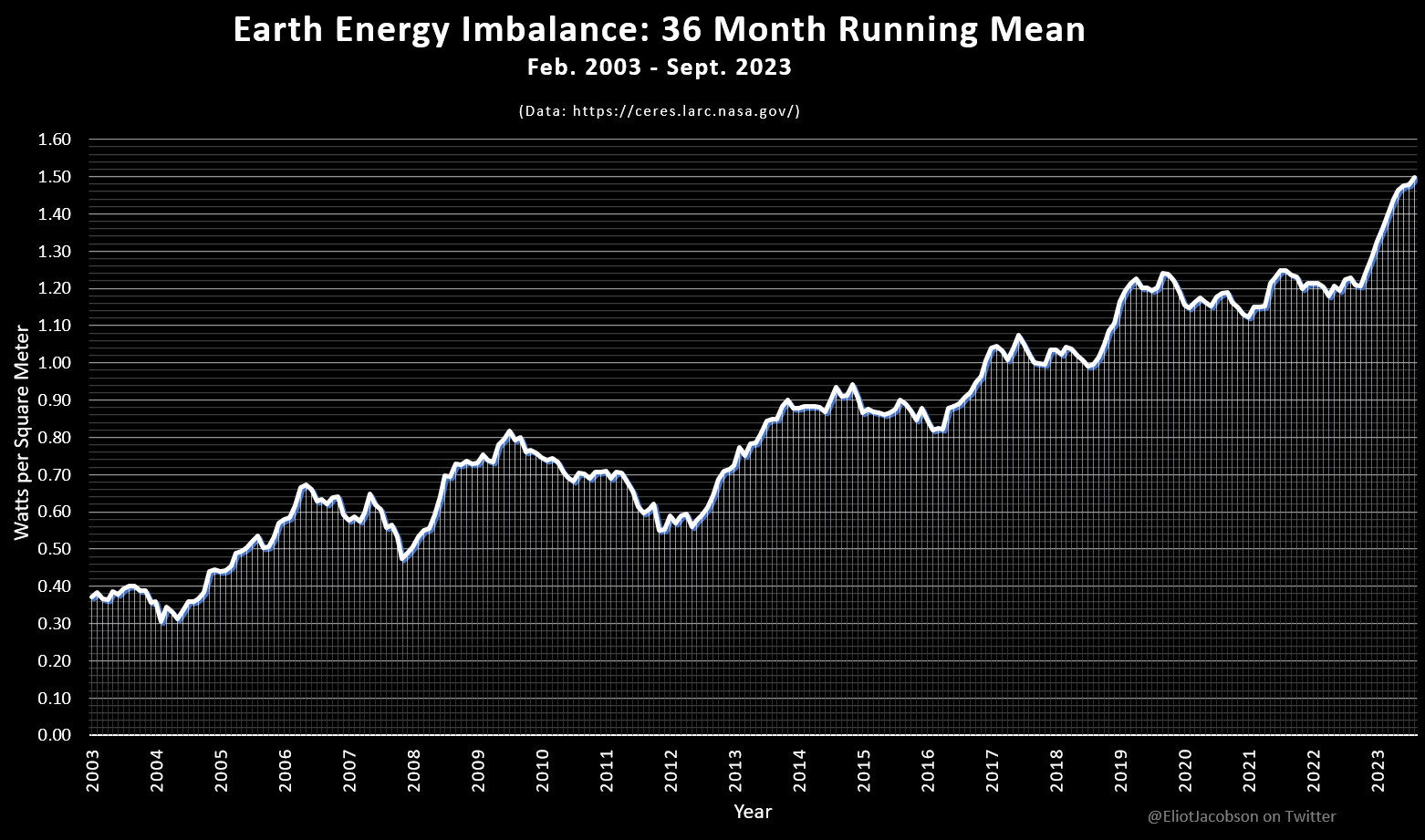
The primary driver of global temperature change is Earth’s energy imbalance (EEI). EEI represents the difference between the energy Earth receives from the Sun and the energy Earth reflects and radiates back into space. This imbalance is a critical metric for understanding climate change. Today, we have accurate measurements of EEI thanks to precise satellite data. (Hansen et al., 2023)
Greenhouse Gases trapping heat
To interpret global temperature changes, it is essential to understand the principal forcings affecting EEI: human-made greenhouse gases (GHGs) and atmospheric aerosols. GHGs such as carbon dioxide or methane trap heat, reducing the amount of radiation that escapes into space. This creates a positive energy imbalance that leads to warming. Aerosols, on the other hand, reflect sunlight, contributing a cooling effect by creating a negative impact on EEI.
The important role of aerosols that form clouds
Clouds are an essential part of the Earth’s climate. Clouds block the sun and shade the ground, cooling the planet’s surface and the atmosphere. Clouds also transport water around the globe in the form of moisture and rainfall. How do clouds form then? They are formed around tiny airborne particles called aerosols. Depending on the type of aerosols—some particles are better seeds for clouds than others. When many new cloud droplets grow, a cloud is created. (The Department of Energy (DOE) Office of Science)
Many aerosols are natural materials eg from sea spray, volcanoes, dust or sand storms. These aerosols are natural but not from plants or animals. Other aerosols come from plants and microbes and from the combustion of carbon-based materials. (The Department of Energy (DOE) Office of Science). Depending on the source of aerosol, different type of clouds are formed. Clouds in turn can reflect light, ultraviolet light, and heat from the Sun away from the Earth. This helps stabilize the temperature of the Earth’s atmosphere. (The Department of Energy (DOE) Office of Science)
Oceans: The Silent Heat Absorbers
Oceans have been absorbing the majority of the world’s excess heat. By the end of March, the surface temperature of the world’s oceans reached unprecedented levels in the 40 years of satellite measurements (Readfearn, 2023). The ocean’s heat capacity is immense, capturing more than 90% of the energy imbalance caused by human activities. Between 1971 and 2018, the ocean gained 396 zettajoules of heat—equivalent to the energy of more than 25 billion Hiroshima atomic bombs (Readfearn, 2023).
The Unattainable Goal of the Paris Agreement
The evidence suggests that the goal of the Paris Agreement—to keep global warming well below 2°C—is already unattainable if policies are limited to emission reductions and uncertain CO₂ removal methods. Global warming and emissions in the pipeline ensure that surpassing this target is inevitable (Hansen et al., 2023)
The Need for Immediate and Informed Action
The ongoing global warming is a direct result of Earth’s energy imbalance. As Earth absorbs more energy from the Sun than it radiates back into space, temperatures will continue to rise as long as this imbalance persists. Immediate, informed action is necessary to mitigate the accelerating pace of global warming. While GHGs are well-measured and their impacts well-understood, aerosol forcing requires further investigation. Nonetheless, the evidence is clear: effective actions now are crucial to address the growing threat of climate change and secure a hospitable future for younger generations.
References
Hansen, J., et al. (2023). How We Know that Global Warming is Accelerating and that the Goal of the Paris Agreement is Dead. Link.
Jacobsen, E. (2023). The “Keeling Curve” for the Earth Energy Imbalance. Climate Casino. Link.
Readfearn, G. (2023). Oceans have been absorbing the world’s extra heat. But there’s a huge payback. The Guardian. Link.
The Department of Energy (DOE) Office of Science (2023). Link.